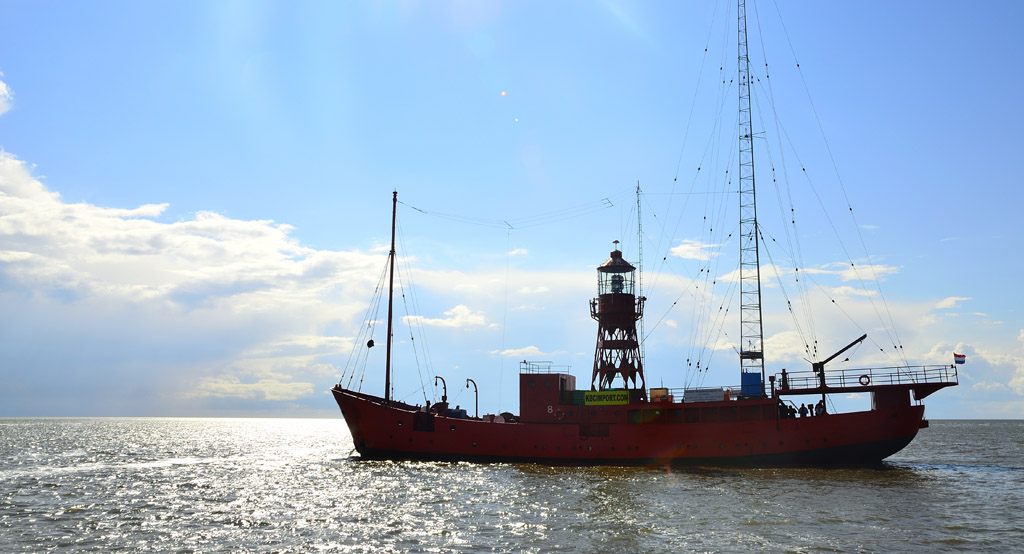
The radiolightship 'Janni Baynton' is the home of our radio station.
The ship
The ship was completed in 1948 and built by the shipyard Philip & Son in Dartmouth, Devon, England. Its length overall is nearly 42 meters; however, because the helicopter deck extends quite a distance, the length of the ship itself is just under 37 meters. With a beam of over 7.5 meters and a draft of 3.10 meters, the vessel has a displacement of 520,000 kilograms. It functioned as a floating lighthouse on serveral locations off the British coast from 1959 until 1991 when it was decommissioned.
Service history
Owned and operated by Trinity House—the official lighthouse authority for England and Wales—LV8 spent decades guarding crucial positions. Rather than staying in one spot eternally, lightvessels frequently rotated between different operational stations.Between 1949 and 1975, LV8 was deployed at several notable North Sea locations:
- Kentish Rock
- Sunk
- Dudgeon
- Outer Gabbard
- Tongue
Second live: Discotheque & Radioship
After its retirement from service, the vessel went through a series of transformations:
The Rotterdam Era: Following its sale in 1991, the ship was towed to the Netherlands where it briefly served as a floating discotheque in Rotterdam under the name Barocca. It was later moved to Moerdijk before returning to Rotterdam in 2004.
In 2005, the ship was purchased by the organization behind Radio Seagull and Radio Waddenzee. It was towed to Harlingen Harbour, where it underwent extensive restoration. Renamed the Jenni Baynton, a massive radio mast was installed on deck in 2007.
Today, LV8 is one of the last remaining functional radio lightships. It serves as a permanent broadcasting base for Radio Seagull, operating as a beloved historical landmark that frequently hosts public tours and special events commemorating the golden era of offshore radio.
Capacity
The original storage tanks for drinking water are still in place and have a capacity of just under 20,000 liters. The fuel (diesel) storage tank was emptied and filled with concrete during the ship’s conversion into a discotheque (1991-2000). The current fuel storage capacity is 2,500 liters. Water is pressurized within the pipes by a hydrophore pump, ensuring that the plumbing system operates at the same pressure as a typical household system. Fuel is pumped from the main bunker tank to a daily service tank.
Generators
To begin with, you need electricity. While this can be drawn from the shore when the ship is docked at a quay, an internal energy source is essential for living and working in locations where shore power is unavailable—such as out in the middle of the sea. As of 2011, the 'Jenni Baynton' is equipped with two generators: a 20KVA Lister (Diesel) and a 12,6 KVA Lister Petter (Diesel).
Name
The ship initially was nameless, it simply was the Trinity House Lightvessel 8, shorened to LV8. Nowadays, the ship is known as the 'Jenni Baynton'. There is a story behind the reason the ship was renamed and funny enough the reason to call the ship 'Jenni Baynton' was not Jenni herself but a man called Dave Francis.
Dave Francis was a very loyal and devoted crew member in the first years of our existence, when Radio Seagull was struggling to survive. Dave was from Hoddesdon UK and used to work for Thames Water until he retired early. He got involved in offshore radio in the sixties when Radio Caroline anchored off the Isle of Man. He never became the DJ he might have wanted to be deep in his heart, but he did contribute to the offshore station in many ways.
It was in 1997 or 1998 when Dave proposed to Jenni Baynton on the Radio Caroline ship Ross Revenge, at that time moored at Queenborough on the Isle of Sheppey. Sadly after some time, Jenni was diagnosed cancer and passed away July 15th 2000. We suggested to Dave to name the ship after his beloved Jenni, and he was thrilled!. Dave passed away a few years later. Our ship is in loving memory of them both.
Friends of the lightship foundation
The foundation 'Vrienden van het Lichtschip' is the owner of the radio lightship Jenni Baynton and is responsible for the restoration, maintenance, and operation of the ship.
The radio lightship is based in Harlingen, where it is usually moored in a prominent position at the Zuiderpier. The ship, originally built as a floating lighthouse to guide busy shipping traffic in the Thames estuary, was transformed into a broadcasting ship after a brief period as a discotheque, equipped with the full infrastructure of a radio station. The ship also provides accommodation for 12 crew members or guests.
The ship is a plug & play radio station, but naturally also an enormous eye-catcher. Both qualities may be reasons to want to use the ship for an event.